
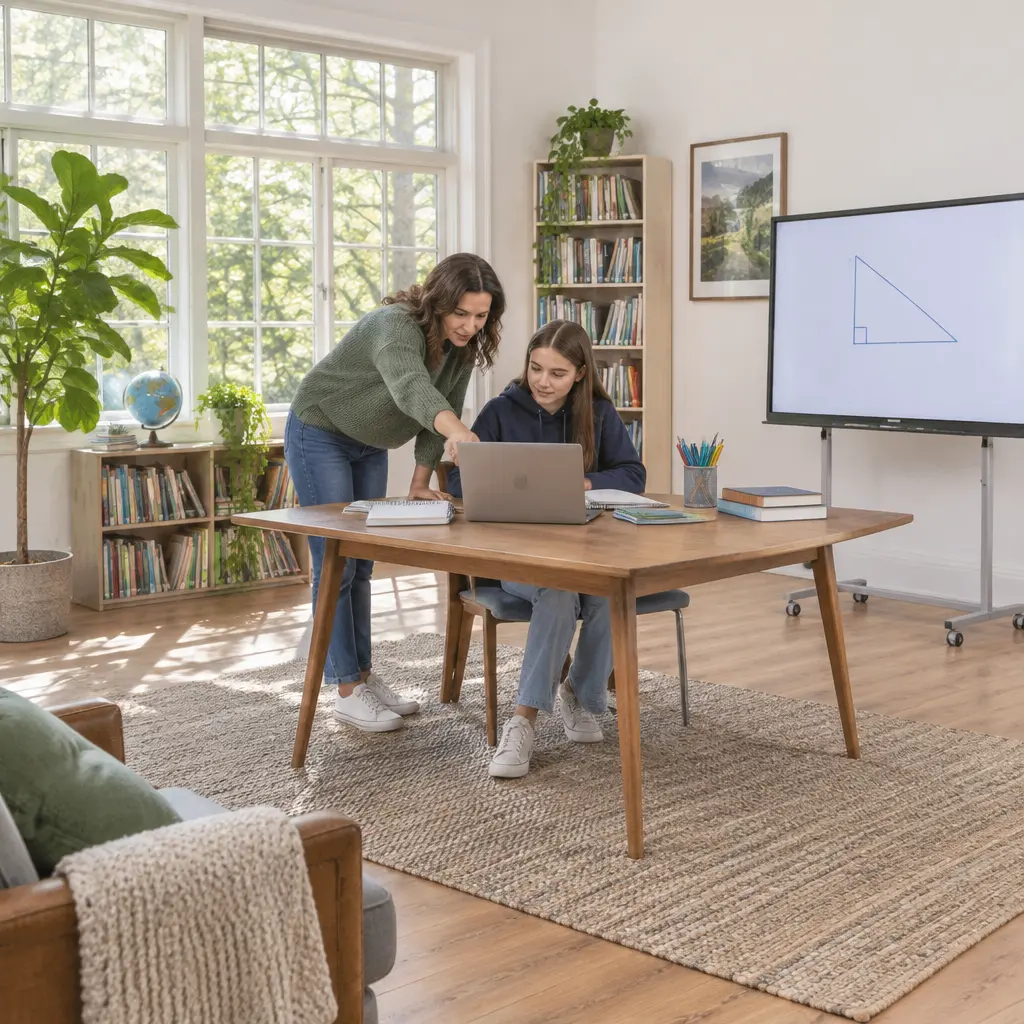
An online tutoring routine is a planned cycle of independent study and live, remote instruction designed to help a learner meet specific goals. A workable routine pairs short, regular study sessions with tutor meetings that target the learner’s needs, then uses practice and feedback to guide what happens next. This structure matters: the U.S. Department of Education’s review of tutoring research found that tutoring can improve academic outcomes, particularly when it is frequent, delivered consistently, and aligned with classroom learning. The sections below explain how to design the schedule, make tutoring sessions effective, sustain independent work, and assess progress.
Designing a Remote Study Routine With an Online Tutor
A remote study routine is a repeatable plan for when, where, and how a student studies online and works with a tutor. The U.S. Department of Education’s What Works Clearinghouse describes tutoring as targeted instruction in which a tutor works with a student or small group to strengthen academic skills. In practice, a routine combines scheduled tutoring, independent practice, review, and progress checks rather than treating the tutor meeting as the only study activity.
Useful routines share several characteristics: clear learning goals, a predictable calendar, manageable study blocks, active practice, and a way to track what is improving. The National Student Support Accelerator at Stanford University emphasizes that effective high-impact tutoring is frequent, consistent, relationship-based, and connected to students’ coursework. Those principles can guide online tutoring too, although the schedule and methods should fit the learner’s age, subject, and circumstances.
Set a specific learning goal
A learning goal states what the student should be able to do, not merely how long they plan to study. “Solve linear equations with fractions” is more useful than “work on math.” Before the first session, the student and tutor can review a recent assignment, quiz, or reading task and identify one or two priorities. This helps the tutor connect instruction to current coursework and gives each study block a clear purpose.
Choose a sustainable schedule
A sustainable schedule balances tutor meetings with independent work and rest. For example, a learner might meet a tutor twice a week, complete two short practice blocks between meetings, and reserve one weekly review period. The exact frequency should depend on need and availability; consistency is more important than creating an ambitious plan that quickly becomes difficult to maintain. The National Student Support Accelerator notes that high-impact tutoring models commonly provide multiple sessions per week, but individual home routines should be adapted rather than assumed to match a school-based program.
Preparing for Online Tutoring Sessions
Preparation turns a remote meeting from a general conversation into focused instruction. Students should bring the relevant course materials, identify where they got stuck, and check that their device and connection work. The tutor can then spend more time diagnosing misunderstandings, modeling strategies, and observing the student’s own attempts. This preparation also creates a bridge from independent study to live tutoring: questions that arise during practice become the agenda for the next session.
Create a reliable study setup
A study setup is the physical and digital environment used for learning. Choose a reasonably quiet, well-lit location; keep course materials within reach; and close unrelated tabs or notifications where possible. Test the tutoring platform, audio, camera, and any shared whiteboard before the meeting. For students who rely on a phone or limited bandwidth, agreeing on a backup method—such as a phone call or emailed worksheet—can prevent a technical issue from derailing the session.
Bring an agenda and evidence of effort
A session agenda is a short list of questions or tasks the student wants to address. It might include a confusing homework problem, a concept from class, and a goal for the meeting. Showing attempted work helps the tutor distinguish a knowledge gap from a calculation or instruction-reading error. It also supports more useful feedback: the tutor can respond to the learner’s reasoning rather than simply provide an answer.
Making Online Tutor Sessions Active and Productive
An effective tutoring session is interactive: the tutor explains and models, but the student also practices, explains ideas, and receives feedback. The Institute of Education Sciences’ practice guide on organizing instruction recommends teaching with worked examples and asking questions that help students explain and elaborate on what they are learning. In an online setting, these methods can be used through shared documents, digital whiteboards, screen sharing, and spoken reasoning.
Use explanation, modeling, and guided practice
Guided practice means that a tutor supports a learner while the learner attempts a task, then gradually reduces help as competence grows. A tutor might solve one example aloud, work through a similar problem with the student, and then ask the student to complete a new example independently. Asking the student to explain why each step works can reveal misconceptions that a correct final answer might hide.
End each session with a next-step plan
A next-step plan records what the student learned, what still feels difficult, and what to practice before the next meeting. Keep it brief: one skill to review, a small set of practice items, and a date for checking progress. This is especially useful for remote learning because student and tutor may not share a classroom or see one another between sessions. A written plan preserves continuity and makes the following meeting easier to start.
Building Independent Study Between Tutor Meetings
Independent study is the planned work a student completes without the tutor present. It matters because tutoring time is limited, and learners need opportunities to retrieve, apply, and revisit what they have learned. The Institute of Education Sciences recommends spacing learning over time and using quizzing to help students identify what they know and what requires more review. These approaches make short practice sessions more purposeful than simply rereading notes.
Use short, focused study blocks
A focused study block has one defined task, a clear stopping point, and a short break afterward. A student might spend 25 minutes practicing a set of problems, then take a brief break and record errors to discuss with the tutor. That duration is an example, not a universal research-backed prescription; younger learners, demanding assignments, and individual attention needs may call for shorter or longer blocks. The key is to make the task specific enough to begin and finish.
Apply spaced practice and self-testing
Spaced practice revisits information across multiple sessions rather than concentrating all review in one sitting. Self-testing means trying to recall or use information before looking at the answer. For example, a language learner can retrieve vocabulary from memory, while a science student can draw a process diagram from a blank page. The Institute of Education Sciences identifies spacing and quizzing as useful learning strategies, and the student can bring missed questions to the tutor for targeted explanation.
Tracking Progress and Adjusting the Routine
Progress tracking is the regular collection of evidence about learning, such as completed practice, error patterns, quiz results, and the student’s confidence with a skill. A simple record helps the student and tutor decide whether to continue, increase difficulty, or revisit a prerequisite. Grades can be informative, but they are not the only measure: improvement in accuracy, independence, and the ability to explain reasoning can also show growth.
Keep a brief learning log
A learning log is a short record of each study session. Students can note the date, topic, work completed, one success, and one question that remains. Reviewing the log weekly helps identify patterns—for instance, whether a particular type of problem repeatedly causes difficulty or whether a planned study time is unrealistic. The tutor can use those observations to tailor explanations and choose the next practice task.
Review the routine regularly
A routine should change when evidence shows that it is not working. If the learner arrives unprepared, reduce the amount of between-session work or make the tasks more specific. If practice is consistently accurate and the student can explain the method, increase challenge or shift attention to a new goal. A short weekly check-in can cover three questions: What improved? What remains confusing? What is the next manageable step?
Conclusion: Make the Routine Consistent, Active, and Adaptable
Building a remote study routine with an online tutor means connecting clear goals, reliable preparation, active instruction, independent practice, and regular progress checks. Research and guidance from the U.S. Department of Education, the National Student Support Accelerator, and the Institute of Education Sciences support the value of targeted instruction, consistent learning opportunities, spacing, and self-testing. Start with a realistic weekly schedule, bring specific questions to each session, and use evidence from practice to adjust the plan. Students and families can also consult the cited research organizations for further guidance on tutoring and effective study strategies.
Sources: U.S. Department of Education, What Works Clearinghouse, “Tutoring Programs,” https://ies.ed.gov/ncee/wwc/Intervention/1007; National Student Support Accelerator, “High-Impact Tutoring,” https://studentsupportaccelerator.org/definition; Institute of Education Sciences, “Organizing Instruction and Study to Improve Student Learning,” https://ies.ed.gov/ncee/wwc/PracticeGuide/1.